Showing posts with label Chewing. Show all posts

Thursday, 20 December 2018

How to Prevent Dog & Puppy Separation Anxiety


There is an alarming number of dogs that suffer from separation anxiety, statistics show up to 14% is possible in the dog population. Not many dog owners understand what this condition is and when they try and fix the problem, they fall short because they have a different viewpoint to the cause and problem. The solution is quite simple on how to help a puppy with separation anxiety or a dog of any age. Establish that you are the pack leader and your dog will no longer be burdened with anxiety. Let me elaborate.

The first step in treating anxiety in your dog is to familiarise yourself with the behavior your dog is presently showing and if the behavior dissipates when you return? If this is the case, I can guarantee that not being present with your dog is directly linked to the cause. Now to look at the key puppy separation anxiety symptoms.


Chewing - Similar to when humans do it with gum, this releases endorphins (a chemical in the brain that makes you experience pleasure) that provide a calming sensation.


Excessive Barking, whining - This is what dogs use when they are trying to call their owners back to the pack, an example of this in a family would be if you were to call your children if you don't know they're whereabouts.

Escaping when you are not there - Often very destructive, extreme and sometimes dangerous. Your dog is looking for you. So many people are told to try and exercise the problem out of their dog but it will not solve the problem


Pulling the Houdini Act of Escaping when you're not home - Your dog is searching for you, this can often result in very destructive, extreme and sometimes dangerous behavior on behalf of the dog.


Digging, destruction - This is typical of a dog who is presenting stressful and anxious behavior


Self-harming - Chewing on themselves, licking excessively or drooling is a sign of stress and can be confused with medical conditions but are all related back to the dog being under immense stress.


Toileting - If you notice that your dog is toileting inside when normally they don't and you suspect it's a behavioral problem it's more than likely the case. If this only happens when you're away from your dog then this can be seen as key puppy separation anxiety signs.

Whilst there are lots of places that you can find advice on how to treat all these symptoms there is only one way to treat the cause of the problem. If you are serious about how to stop separation anxiety then you must become the pack leader.

There are many different sources of information on treating this condition but if you are serious about putting a stop to separation anxiety then you must become the pack leader.

The main cause for separation anxiety in puppies and dogs is they think they themselves are the pack leader and whenever you leave the house it's a member of their pack leaving! In the wild dogs tend to keep grouped together and will always make sure they are close by to each other. When you leave the house your dog's anxiety will return, however, if you establish yourself as the pack leader you will find your dog is completely calm and fine with you coming and going as you please.


Source:http://ezinearticles.com/?How-to-Prevent-Dog-and-Puppy-Separation-Anxiety&id=9305973

Wednesday, 31 October 2018

5 Common Signs of Dog Separation Anxiety To Watch Out For


If you notice that your pet dog has been acting up lately and you don't know why, he may be experiencing separation anxiety which is a common issue in canines. It is when they feel stressed when left alone resulting in negative behavior. Any dog parent or pet owner should be able to tell the difference between a dog being sad when their owner leaves the house and the more serious separation anxiety. Knowing the symptoms will be a great deal of help to fight the issue or even prevent it.

Here are 5 common signs of dog separation anxiety that should be observed:

Barking
Barking or whining (or both) is the most common sign of separation anxiety in dogs. They would usually start this behavior once their owner leaves and won't stop until they return. The barking is a cry for their owner to come back to the pack.

Chewing

While dogs naturally love to chew on just about anything, excessive and destructive chewing is a separation anxiety symptom. This behavior in canines is similar to when humans chew gum in order to stay calm.

Digging

When a dog is stressed, one usual behavior would be digging. This is usually accompanied by general destruction so if you find that one of your shoes have been chewed on, papers in your house are scattered and played with and other similar scenarios while you were gone, you should start observing your pet, especially if it is accompanied by digging.

Drooling

While almost all dogs drool, it can be a sign of stress when excessive. It is hard to tell whether excessive drooling is medical related or due to the stress of separation anxiety, so try to be more observant. If your pet has this issue all of a sudden and you're not sure of the cause, it is best to consult with your veterinarian.

Peeing and Pooping


Another common sign of dog separation anxiety is urinating or pooping inside the house, especially if your pet is potty trained or knows how to do his business outside. If this happens only when you are away, it means that your pet is indeed stressed.

Separation anxiety in dogs is a serious condition. Canines are naturally loyal and loving and it makes them sad when they are away from you which they see as the leader of their pack. Watch out for these signs to help fight the issue!


Source:http://ezinearticles.com/?5-Common-Signs-of-Dog-Separation-Anxiety-To-Watch-Out-For&id=9799476

Tuesday, 23 October 2018

Playing is Important For Your Puppy or Dog!


Playing is as important for your dog as breathing and eating. In order to have a dog that is properly mentally and physically developed, it is essential that play is part of its growth process. 

Without a chance to play, whether it is with people, other dogs or even just a puppy playing with itself, a dog will not grow into a fully developed adult dog. Play is a very important requirement in order to produce a dog that is emotionally, physically, mentally and socially ready to function as a socially acceptable adult dog. 

Puppies at play are learning to communicate with each other, they are learning how to fight without hurting the other dog, they practice hunting techniques and they have fun. 

There are two schools of thought on puppy play. Some trainers think that a puppy should be allowed at least 30 minutes of free play each day. It is thought that this helps develop the puppy's brain, while the other school of thought believes that a puppy should receive training and direction as soon as possible in order to avoid learning bad habits. 


How do puppies play? Puppies generally jump around from one form of activity to another with chewing, nipping, tugging and play fighting being the chief forms of play. In many breeds there are certain characteristics that stand out, as in hunting dogs the idea of stalking and hunting seems to be easy to observe. 


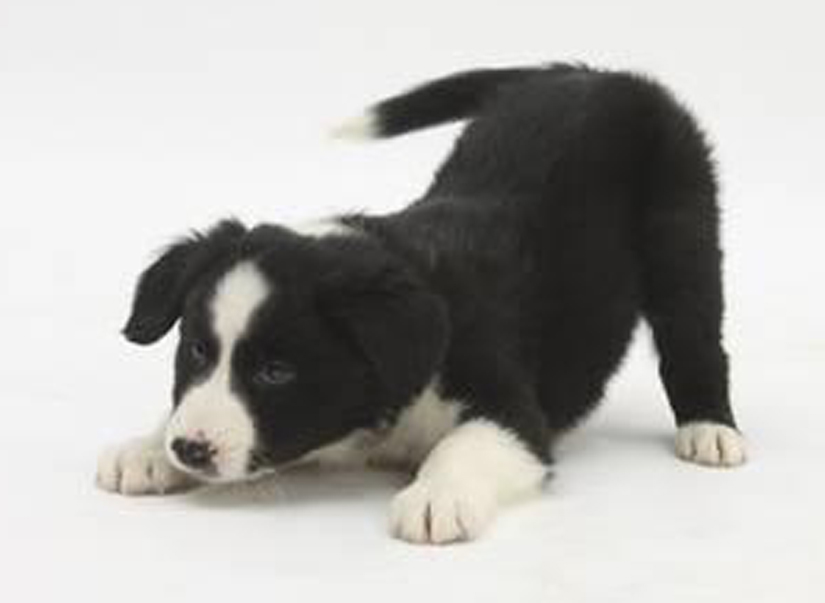
A play bow seems to be an important way a dog communicates with another dog. A play bow is when the front legs are down in front of the puppy and the hind quarters are up in the air with a tail that wags or not. This is an invitation to come and fool around; I want to have some fun. The muscles should be loose and relaxed and not tight and stiff. The play bow also tells the other puppy/dog that if I accidentally nip or bite you I am only fooling and I am sorry. 

A play bow with the puppy running means chase me. If the puppy/dog has a toy in its mouth it is an invitation for the other dog to chase and try to get the toy. 

Wrestling and nipping during play is a way for a puppy/dog to learn how to control its bite. If the puppy continually bites too hard its playmate generally will leave the play and the biting puppy begins to learn a valuable lesson. 

Puppy play is usually mock fighting, it is a way to learn how to fight and protect themselves, but also a lesson in controlling their bite and ferociousness. 


At times the puppies may get into a pinning match where one dog places its head or body over another dog. In play the underdog can usually wiggle out, but once in a while it gets into a growling match as the top dog begins to feel dominant. In this case it maybe necessary for the owners to separate the puppies and get them to calm down. 

A sign of play is loose muscles and joints and they are moving a lot, however a sign of stiff joints and muscles can relate to an over-excited dog that may start a scuffle or fight. In this case redirection of the dog's attention is necessary. 

Puppies/dogs do not have hands and as a result everything must go into their mouths. Chewing is a puppy's way of life and is an important factor in their growing up. As the humans in the equation it is up us to supply proper toys for the puppy/dog to chew on. 

Puppies learn proper behavior when allowed to stay with its littermates and mother until they are at least 8 weeks to 10 weeks old. During that time mom and the siblings have a chance to correct any improper nipping and biting. 


A tug of war is a game puppies/dogs love to play as it gives them a feel of resistance against their teeth and is beneficial in helping to develop jaw and neck muscles. Use and old sock or bandana the goes limp when you or the other puppy lets loose, this is one way to have the dog bring it back to you for more play. Be careful between the ages of 3 to 6 months and do not play too rough as the puppy is getting its adult teeth and you could damage them. 

It is suggested that you play with your puppy/dog for at least 15 to 20 minutes a day and stop when the puppy/dog gets tired or becomes bored. 

Some other things to keep in mind are offer your puppy/dog a fair amount of toys to play with. Do not allow your puppy under a year to jump on couches, beds or on agility jumps as their bones are still fragile. Do not physically punish you puppy by throwing it to the ground or pinning it down if it misbehaves in play. Sometimes an older dog that will play with your aggressive pup can teach it more by a simple growl or snap. Physical punishment is not necessary to teach anyone anything, puppy or child. 

Puppies need to have new experiences and see new things in order to grow into a socially acceptable dog. Do not force your dog to do or face anything it is afraid of. Use treats and praise to show the dog that thunder, yelling children or any thing else it seems fearful of is not scary. 

And most of all let your puppy/dog have at least 30 minutes of free play everyday, having fun is good for us all. Be happy and enjoy your dog and you will have a friend for life.


Source:http://ezinearticles.com/?Playing-is-Important-For-Your-Puppy-or-Dog!&id=2167306

Wednesday, 25 July 2018

Why Isn't Punishment An Effective Training Method For Puppies


Have you recently received a new puppy? For many people, this is a very joyous time in their life. Unfortunately, it's not always fun when you are raising a puppy simply because they can become very unruly and are also hard to train. It could be simple things like teaching them not to chew on literally everything that is in your household, or teaching them how to not go to the bathroom on your carpet or floor. It can push you to your emotional limits, causing you to want to punish them every time that they make a bad choice, but this might not be the best way to train your puppy. Here are a few reasons why punishment is not an effective training method for puppies, and what alternatives exist that may prove to be much more beneficial.

Why Punishing Your Puppy Is Not The Best Choice


Starting with a simple example of a puppy that is chewing on a piece of furniture in your home, your first inclination would be to use a rolled up newspaper, smacked them on the nose, and tell them in a very affirmative tone that they have done something wrong. Obviously, the dog is not going to understand the words that you are using, but your tone will speak volumes. However, is smacking them on the nose, or swatting them with your hand, actually the best choice that you can make?

Alternatives To Punishment

There are a couple different alternatives to actually physically striking the dog in order to get your point across. We have already mentioned that the tone that you use is very important when you are trying to train your puppy. This applies to any problem that they may be having which could be biting, scratching, digging, or not waiting to go outside in order to relieve themselves. In conjunction with your negative tone, the alternatives that you will want to use will include removing them from the situation, all the while telling them in a strong condescending tone that they have made the wrong choice. It doesn't matter what words you use, but your actions need to be fast, quickly addressing the issue and removing them from the situation. You could take them to a different area of the home, or if it is a problem with potty training, take them outside and then begin the second stage of the process.

Rewards For Improving Behavior


Once you have removed them from the situation, you will want to immediately reinforce the bad behavior with presenting them with the option to do something good. Once they are in the new location, you can ask them to set, or lie down, something that they already know how to do, and when this is accomplished, you can reward them with a positive tone and some form of treat. By doing this quickly, transitioning them from the bad situation to a good one, and then following that up with a reward, they will become aware that making good decisions leads to rewards and praise from their owner, and theoretically through this process, the need to be praised and receive rewards will carry over to the problematic area. This can inspire them to avoid doing the bad things, hoping to do good things in order to receive positive input from you. Once done several times, and done on a consistent basis, you should start to notice a definite change in their bad behavior, transitioning them into something good.
The reason that this particular strategy does not work all of the time has to do with the lack of consistency on the part of the owner. The transition needs to be immediate, which is why in the early stages of raising your puppy, you need to be there as much as possible. By giving them an appropriate toy to chew on, or placing them outside where they can actually relieve themselves, and rewarding them once the good behavior has been accomplished, they will begin to understand. As long as this form of positive conditioning is used on a consistent basis, you can avoid the need for punishing your puppy in order to train them, it's a philosophy that many dog owners are adopting today.


Source:http://ezinearticles.com/?Why-Isnt-Punishment-An-Effective-Training-Method-For-Puppies&id=9037837

Monday, 11 June 2018

The Early Signs of Dog Behavior Problems

If you have a dog, then you know how it can be sometimes difficult to train your pet. Regardless of the breed, dogs have different personalities and all exhibit different behaviors. However, there are some common behavioral problems that, if spotted early, you as an owner can completely reverse the problems. Let's take a look at the different behavioral problems exhibited by dogs.


The first behavioral problem one would notice is that dogs like to dig. If you're one of the few people that do not mind your dog digging up your lawn, then disregard this, but good owners should train their dogs to stop digging. To train a dog to not dig successfully, you will need to catch your pet in the act of digging and stop it. It is important to stop your dog in the middle as this will help them learn that digging is sometimes not correct.


The second behavioral problem is chewing. Dogs and puppies like to discover the world they inhabit by utilizing their mouth. Whether its for exploration or calming, they need to understand that they should not be eating things that is not food for them. Its utmost important to stop this habit as it can have health consequences. One way to do this is to give your dog chew toys.


Begging is another behavioral problem in dogs. Dogs will often beg for food especially if they see the whole family eating together at the dinner table. You can reduce this behavior by never giving your food from the dinner table to your dog. This may seem cruel, but you can always take the dog to a different room, or even the same room, and put food in the dog's food bowl. This way the dog will understand that it has a special bowl and a special spot to eat.


Aggression is also a very common behavioral problem seen in dogs. This behavior is actually the prime reason why dogs seem such violent creatures, but in reality it is the training they receive that makes them so. If a trainer can control the dog's aggression and potentially reduce it, then it is a safer pet than before.


Sometimes dogs like to pull on the leash when you take them for a walk. Never let the dog pull the leash because if you let them, then the dog will wrongfully understand that pulling on the leash is a good and allowed behavior. Always make sure that if need be, you pull the leash and eventually your dog will learn to walk calmly and carefully beside you.

Lastly attention is also a behavioral problem in dogs. However this is a controversial topic as some people like to give a lot of attention to their dog. But be careful, as this may make your dog spoiled.

In conclusion, behavioral problems in dogs is a large list because of the varying behaviors of dogs. If these behaviors are sighted early, it is easier to reduce them.


Source:http://ezinearticles.com/?The-Early-Signs-of-Dog-Behavior-Problems&id=8875961

Thursday, 8 March 2018

5 Common Dog Behavior Problems


If you are a dog owner then at sometime or another you've experienced some type of behavior problems with your dogs. In this article we will talk about 5 of the most common dog behavior problems.

1. Okay let's start with jumping. You may have a dog that's jumping on you, on the kids, or maybe visitors that come to your home. No matter what, jumping can be very annoying and actually dangerous when it comes to small children or senior citizens.


2. Barking is another problem that you may have experienced. It seems that most people don't mind their dog barking to let them know that somebody is at the door or even somebody is outside that shouldn't be. However none of us want that nonstop barking that annoys the neighbors and keeps you from being able to enjoy the peace and quiet of home. Teaching your dog to stop barking on command is the answer.


3. House training is another huge issue for some people. If your dog has not been properly house trained then your dog is probably soiling in your home. Let's face it that just isn't acceptable. In fact the lack of house training is the number one reason dogs end up in shelters.

4. Chewing is one of those habits that we want to eliminate quickly. If you have a puppy that's chewing on things you'll have an adult that does the same thing unless you break that habit early.


5. Digging can be very annoying and dangerous for your dog. Dogs dig for different reasons sometimes just out of boredom, other times to find cool ground, and other times to escape under the fence. Digging holes in your backyard can be very unsightly but digging holes under the fence can be dangerous because your dog can escape and possibly get run over.

I'm sure you're asking now that we've identified some of the common behavior issues how do we solve them. The answer is actually very simple, training and behavior modification. It's amazing but behavior problems all seem to disappear if your dog is obedience trained.


Other problems will require some behavior modification. What is behavior modification? Simply changing the way you do some things at home with your dog so that it is able to learn better habits.

If your dog is suffering from these common behavior problems simply find a good trainer in your area that can guide you through the steps to eliminate the issues.


Source:http://ezinearticles.com/?5-Common-Dog-Behavior-Problems&id=8490327


Wednesday, 4 October 2017

Separation Anxiety In Dogs Revealed


A very common complaint amongst dog owners is that their dogs get into trouble when they are gone. They will become destructive by chewing things around them, going potty where they shouldn't, or try and escape.


If your dog starts drooling or showing signs of distress when you are about to leave your home, these are not symptoms that your dog has not been house trained, or doesn't know which toys are his for chewing. These are symptoms that your dog suffers from separation anxiety and are triggered when your dog becomes separated from their owners and gets upset.


Separation anxiety in dogs can cause them to try and escape. This means they will try and get out of the room they are in, which can cause injury and or household destruction, especially with windows and doors. If you see your dog getting agitated or anxious before you leave, or even depressed before you go, your dog suffers from separation anxiety and sometimes will try and prevent their guardians from leaving.

Another tell tale sign of this issue in dogs is that they begin barking or displaying other distress signs shortly after you leave, and when you come home it seems like it has been years since your dog last saw you. Here are some of the common symptoms of separation anxiety in dogs.


Chewing, digging or destruction is a very good sign that your dog suffers from separation anxiety, and they can hurt themselves in the process. They can chew on door frames and window sills, and dig at doorways. The damage they obtain from this behavior is broken teeth, damaged nails and scraped paws.

Barking and howling are more of these symptoms. They bark or howl when left alone and they will be persistent when doing this. Another symptom of dog anxiety is when a dog trots along a specific path in a fixed pattern when left alone. The pattern can be in a circle or a straight line. You will know that this behavior is anxiety if your dog does not do it in your presence.


There are a number of reasons why your dog may suffer from being separated from you, though there is no conclusive evidence why dogs develop this. The dogs that have been adopted from shelters seem to have separation anxiety more than dogs that have been raised by a single family since it was a puppy, which tends to make the loss of an important person or people in a dog's life can cause separation anxiety in them.

A change in their schedule, where they live or just plain boredom are causes of separation anxiety in dogs, so keep that in mind when drastically changing what they do and where they live.

You can treat mild separation anxiety in dogs by a technique called counterconditioning, which is a treatment process that changes the animal's aggressive, anxious or fearful reaction to being pleasant and relaxed. You can accomplish this by associating the sight of a disliked person or thing with something that the dog enjoys.

Source:http://ezinearticles.com/?Separation-Anxiety-In-Dogs-Revealed&id=9402128