Friday, 26 October 2018

Caring for Your Pet: Best Tips to Show You Love Animals


Taking care of your pet takes top priority. Just as with kids, any pet parent has many things to worry about. From bathing to clipping nails, the pet parent has to find the required time along with their daily schedules to make their pets happy.

Although you may feel as though you are all over the place if you have no idea on how to make your pet happy or keep them healthy, don't worry. This article will help you with that.

Here are some things every parent can do for their lovely pets:

Take Them Out


Just as you will get dull if all you do is spend time at home, the same stands true for your pet as well. Take your pet out for walks and keep them company. Try to play games with them while you are away. This will keep healthy and happy.

Exercise with them


Going out for a morning jog or run? Take your pet with you. Keep up with your pet and allow the pet to jump around a bit. This daily exercise routine will keep your pet happy and healthy. Moving around will keep the pet from gaining excess weight and will also help them to remain active.

Grooming

Take nearest dog boutique and get them a haircut. Select days on which you need to take your dog for grooming appointments. Make sure you choose the correct place to take your designer pet accessories for grooming. Also, make monthly appointments. Get your pet shampooed, get their nails clipped or give them a haircut, and keep them healthy.

Feed your Pet


Another thing that you need to take care of your pet is to feed them properly. Make sure that your dog is fed sufficiently and is given proper nutrients. If you want, go out and purchase some breed-specific food options for your pet. Other than this, if you do not like store-bought food, give your dog something that you made.

Regular Check-Ups


Get your dog checked up often. Make routine appointments with the vet and get your dog checked. Dogs may contract allergies and other problems, which a doctor will easily get rid off in the initial stages.

Schedule your day and your pet's day

When it comes to keeping yourself and your pet healthy, a regular day schedule will work. Chalk out your day and your pet's day as well and stick to it. A routine helps your pet to stay healthy.

With many ways of showing love to your pets and animals, the best thing you can do for your pet is to take care of them. Be sure to maintain your schedule and make sure that you provide food with all nutrients for your pet. Take your pet out or give them an exciting new gift to keep them engaged. Caring is the best gift you can offer.


Source:http://ezinearticles.com/?Caring-for-Your-Pet:-Best-Tips-to-Show-You-Love-Animals&id=9924094

Walking With Ease


Pulling and dragging on the leash is probably one of the biggest problems for dog walkers and owners alike when it comes to walking our dogs. I am going to share with you 4 easy, well, maybe not so easy, tips that I use to accomplish something I like to call W.W.E., or Walking With Ease.


If your dog is full of hyper energy like some of mine have been in the past then you know fighting with them while on a walk can sometimes resemble a real W.W.E. match. Not only can this be extremely frustrating for you walking the dog, but your dog could also be hurting itself in the process. Especially if you use choker collars, which in my humble opinion is a somewhat cruel way of getting your dog to do what you want. While following these instructions might be a lengthier process, I would encourage it as it will probably yield more satisfying results in the long run.


My first recommendation would be to enroll your dog into puppy training classes when they are still young. These classes work wonders with new puppies, teaching them how to behave in and out of the house and listen to your commands. One of the most important commands you will learn is "heel". For those of you who don't know what heel is, it's the command you use to get your dog to walk alongside of you, as opposed to dragging you along. If you are trying to teach your adult dog new tricks, do not fret. I have witnessed a number of older dogs who have benefited substantially from an attending a class. Maybe this is not your dog, even still, a class is not the only way to train your pet. In fact, learning this command is only the first step in training your dog to walk on a leash.

The next step, is all about you as the human controlling the leash. For this step, think of the leash as a direct connection between you and your dog, where they can literally feel everything through it. Because they can. What I mean by this is any anger, aggression or nervousness you feel is channeled through your grip on the leash and transferred from you to them. Doesn't it just amaze you how cool dogs are? Keeping this in mind though, it is important to stay calm and confident even when you feel like you are losing control. Also, try not to get angry at your dog, especially verbally. Patience might be hard for you at first, but practice building it over time. Believe it or not, the more relaxed you are, the more your pet will be in return, and the more likely they will be to follow your commands on a consistent basis. It is important that you have a mutual relationship built on love rather than just trying to dominate your dog through fear and punishment. This can lead to them rebelling or resenting you. A cool tip I learned to help with this is to change your viewpoint of the situation. Rather than thinking of it as wanting your dog to stop pulling (something that frustrates you) think of it as teaching them to walk calmly with you (more positive).

The next step in learning to walk with ease is developing a positive reward system to encourage the behaviors you like in your dog. For instance, when they correctly respond to heel, you should have a treat on hand to reward them. To start off, you will want to do this every time, gradually leaning them off so they learn to listen whether there is a treat waiting or not. Be sure to not only reward them for following explicit commands for you, but also for other behaviors that will benefit them. For instance, every time your dog yields to streets or traffic without you having to tell them to, be sure to reward that. You might even want to reward them a little extra for these safety habits. This way, in a situation where your dog gets away from you, they will be trained to avoid cars with or without you there. A positive reward system reinforces the loving relationship between you and your dog over one of owner and owned.

Lastly remember to practice, practice, practice. I am not going to bore you with any cliché sayings, but we all know the importance of practice if you want to perfect anything. The same concept applies with your dog. In the beginning, they will try to continue to do their own thing, even with the reward system. But think about it, if you were trapped in one location all day and finally got to explore you would go crazy too! Walking your dog every day will desensitize them to that freedom, and they will learn that the same rules from home apply there. Once the reward system kicks in, use it over and over. Even if it is every half block or so that they walked with you instead of pulling you. As I said, you can wean them off over time once they get a hang of it, and you will be able to tell easily when that time comes.

Overall, this is definitely a process. And I do not want to lie to you and tell you it will be easy. But if you stick it out you will definitely be glad you did. There is nothing like a walking a well trained dog. When you and your pet really sync, you will even be able to walk them without a leash. But that is a lesson for another day. Whether you are dog walking for others or just taking your own dog for a walk around the neighborhood or park, get out there and practice your new skills!


Sourcce:http://ezinearticles.com/?Walking-With-Ease&id=9933532

Thursday, 25 October 2018

How to Choose the Right Shampoo for Your Dog


With such a wide range of dog shampoo products on the market, it can be difficult to know which one to buy. In most cases, the preferred choice will relate to the specific needs of your dog. If in doubt, it is worth speaking to your vet to get advice. Let's take a look at some of the most common options:

General cleansing

Dogs with normal skin and hair are the easiest to find a suitable shampoo product. The shampoos can range from the low-cost products to the more expensive medicated options. Any of the products marked as a shampoo and conditioner will make a practical choice to achieve the fresh smelling dog. Additionally, there are several shampoos that are particularly useful for dogs that tend to quickly get smelly.

Medicated

Any dogs with itchy or dry skin can benefit from a specialist medicated shampoo. It often helps to speak to your vet before buying this type of product because it can be expensive and there is the risk of making the skin condition worse if the wrong shampoo is applied.

Flea treatment


The shampoo designed for flea treatment is a very useful option for the dogs in discomfort due to an annoying breakout of fleas. Most of these products include a special type of insecticide that is typically safe for most dogs, but can be an issue for those with an existing health issue. However, this type of product isn't intended to prevent fleas from attacking a dog, so it is still necessary to maintain a proper cleaning routine for the home and dog.

Allergies

The shampoos intended to help with allergies can benefit both humans and dogs. For instance, any family member that often sneezes when close to a dog will appreciate the use of an anti-danger shampoo. This type of shampoo is designed to help minimize the episodes of scratching, which should cut the allergens that are constantly released into the air. Also, the dog with a skin allergy such as itchy or dry skin will appreciate a shampoo that can give relief from the discomfort.

Only use dog-specific products

It may be tempting to use the everyday human shampoo to give the dog a wash if it gets dirty outside, but this is rarely a good idea. Most human shampoo is way too harsh to use on the dog's sensitive skin. It is always best to wait until the right shampoo is available to avoid causing unnecessary skin issues.


Source:http://ezinearticles.com/?How-to-Choose-the-Right-Shampoo-for-Your-Dog&id=9943597

What Is Dog Separation Anxiety and How to Reduce It


This problem is seen quite often in shelter dogs. I am dealing with this issue as a dog that I just adopted from a shelter has separation anxiety. If the problem is not treated or worked on it can lead to more stressful problems. This problem is not seen in every dog.

Some of the signs to look for are:

Some dogs have a more extreme case of separation anxiety and are more destructive than others.


Destructive like chewing on shoes or furniture, scratching, digging or going to the bathroom on the floors.


Barking, whining, howling.

Depression, lack of appetite, trouble breathing.

Following you from room to room.


The dog starts running in circles as you are getting ready to leave.

Some dogs may attempt to escape from the house to look for you.

Here are some tips to reduce the separation anxiety in your dog.


For a shelter dog that has been adopted is to have patience. The dog will learn new commands better to help combat the issue if he feels that the new home is safe, secure environment. Need to bond with your dog like playing and going on walks. This will help to use up his energy and be ready to relax alone. Create a quiet safe space for the dog only. Over time your dog will learn that he will be safe in that space while you are gone.

Next is to keep departure and arrival low key. This may be hard at first. For departing try not to pay attention to the dog for 10 to 15 minutes before leaving the house. After arriving home ignore the dog for a few minutes, then acknowledge him with some calming petting or hugs.


Offer some more comforting things for the dog by leaving a piece of clothing that will have your scent on it. This will help relax and some sense of familiarity because of your scent. Also, don't forget to leave his favorite toys and treats. Buy some treat games to him busy and the brain mentally stimulating while you are gone.

You could introduce a safety cue to be used such as "that you will be right back" for every time you leave the house. Start small by using the safety cue when you are going outside with the trash. Most of the time you are only gone a few minutes. Then keep building up the time you are away.

At first practice your departure routine by gathering your things that you take every day with you and sit down. Repeat this routine till your dog show no signs of distress. This way you are establishing a routine. Most dogs love having a daily routine with it master.

Don't be cruel to your dog by yelling or ignoring him. This may cause the problem to get worse. Try to calm him down with relaxing petting and talking softly to him in a low tone.

The best piece of advice is to be patient, consistent and persisted in the technique you are using.

Separation anxiety is not a result of lack of training or disobedience but it's a panic response.


Source:http://ezinearticles.com/?What-Is-Dog-Separatuion-Anxiety-and-How-to-Reduce-It&id=9958037

Wednesday, 24 October 2018

Don't Stress Over Your Dog's Small Fatty Tumors!


Dogs seem to acquire small fatty tumors almost as easily as they find smelly things to chew on or roll in. It seems to be a "dog thing," almost like we find a gray hair when we least expect it.

No dog is immune to lipomas, which is a common small fatty tumor, which by definition are benign and sometimes unsightly. In rare occasions they can cause problems.

What is a lipoma? A lipoma is usually a soft and non-painful mass found right under the skin. A true lipoma is never cancerous, however, there are some malignant variants called liposarcomas and infiltrative lipomas, which are locally invasive. Ninety-nine percent of the time lipomas should not cause an owner any need for worry.

Lipomas can appear anywhere on the dog's body, but usually show up on the abdomen and legs. The tumors can range in size from the less than a quarter of an inch to the size of a baseball. It is said that some if neglected for a long period of time can reach basketball size. Somehow, I find it hard to believe that someone would let that happen to his or her dog.

A dog can have several at a time and lipomas do not favor any particular gender or breed of dog. Middle-aged and senior dogs however, seem more prone to them. Any size or age dog can have them; the tumors are not particular.


Even though they are basically harmless, a trip to the vet is a good idea. Your vet will insert a needle into the tumor to confirm that it is benign and discuss whether or not it should be removed.

Lipomas are removed when a vet thinks they may cause pain or impede a dog's movement. A pain causing lipomas would be one located under the "armpit" area (under the dog's foreleg next to its chest). A lipoma in this area would possibly bother the dog while walking. Others would be recommended for removal if the size was large and in an area where a large incision would be necessary.


Some lipomas are removed for cosmetic reasons, though most vets suggest removal for that reason to be put aside until the dog needs to go under anesthesia for another reason. Putting a dog under anesthesia is always a risky endeavor and should only be done when really necessary.

What can be done as a prevention? There is no possible prevention as some dogs are just prone to having them. The only thing you can do is be on the lookout for any lumps or bumps on your dog and have them checked.
liposarcoma

Apparently, the ones to really keep an eye on are lumps that grow quite rapidly and appear to be firmly fixed to the body. This would be a liposarcoma and should be removed and followed up with some radiation therapy. Without some radiation therapy once removed, could spread through the blood to other areas.

Infiltrative lipomas look like an ordinary lipoma under a microscope, but actually have a root type system that will grow into deeper areas including the muscles. This type of tumor is a challenge to remove because of its so-called root system. Both types of these tumors require radiation treatment and sometimes require amputation of a limb.

Amputation is a bitter pill for most dog owners to swallow, however, as a dog owner you need to realize that your pet will adjust to it quickly and very easily. They are not like us and dwell on the loss of a limb; they just find an easy way to get used to not having it, without any fanfare or tears. A lesson we could all learn from.

Since lipomas are part of our dog's life what can we do? Keep a watchful eye on your dog's body. Frequently use your hands when you are petting your dog to wander over its body checking for lumps and bumps. Talk to your vet and whenever you have your dog in for its checkup have the vet look for signs of lipomas.

You can keep track of the size of the tumor by placing a piece of paper over the lump and trace the size; you can then use this guide to measure future growth.

Lipomas are usually nothing to worry about, but it is wise to see you vet and talk to him/her about what to look for. Your vet can give you some guidelines to follow and when in doubt, take a trip to the vet, just to be certain all is well. Your dog deserves proper care and you will have peace of mind.


Source: http://ezinearticles.com/?Dont-Stress-Over-Your-Dogs-Small-Fatty-Tumors!&id=1401332

Are You Building a Good Relationship With Your Dog?


Most of us do not realize that every moment we spend with our dogs, we are not only building a relationship, we are also training them.

Whatever behavior you choose to reinforce, consciously or unconsciously is really a method of training. The many things your dog does, that you like and reinforce with kind words or treats are things your dog will do over and over again.

Dogs are like people, we all enjoy the moments that someone praises us or gives us good feedback about something we have done. We lap it up and feel good about ourselves, well, dogs do too and it is important that we let our dogs know when we are happy with their behavior.

The Center for the Human-Animal Bond at Purdue University School of Veterinary Medicine defines the bond that connects us to our beloved canines as..."the dynamic relationship between people and animals in that each influences the psychological and physiological state of the other." They also state that "People in the presence of animals are often perceived to be more happy and healthy."

But, what about the happiness and health of our pets? We need to do our job as caregivers to ensure that our side of the dog-human bond brings happiness and health to our pets as well.

So what are some of the things we can do to help make our pets happy and build a good relationship.


· One way is to touch our pets every chance we get. Give quick little massages behind the ears as you pass by. Scratch your dog under the chin as you put on its leash. If you cuddle and watch TV together, take time during the commercials to give a belly rub or whatever else your dog enjoys. Let your dog know you care and tell him/her so.

· Make it a point to carry treats with you, especially when going for a walk, use them to reinforce good behaviors and use them as distractions should a something out of the ordinary happen. Sometimes a scary thing can be made more pleasant by the use of a treat.

· Dogs love to learn and by teaching your dog to "say please" (which is sitting to have a leash put on or sitting to go out the open door,) you are teaching a good behavior and making it a pleasant experience by giving treats.


· Play with your dog. Dogs love to have their masters play with them, it is a time for fun and you can even slip in a behavior lesson or two while doing it.

· Say your dog's name before feeding him/her or before giving a treat. Dogs enjoy hearing their names, this reinforces a positive reaction to come when called as the experience is a pleasant one.


· Talk to your dog say "good morning" when you wake up and "good night" when you go to bed. Dogs love to be talked to, I have had some of my best conversations with my dogs and the nice thing is they do not repeat anything.


· Give your dog a special treat when you are leaving the house, a nice long lasting chew, a Kong ball or hide a few treats and tell your pet to go find them.


· Take as many opportunities as you can to build a relationship with your pet, respond to its bid for attention. If you catch your dog looking at you, give it a rub or just say its name and tell it what a good dog it is. Use the tone of your voice to convey a happy feeling, your dog will respond to it.


· Try to notice your dog when it is behaving nicely, like lying in its bed or playing quietly with a toy, acknowledge the behavior with a word, treat or a rub.

· If your dog comes into a room that you are in acknowledge him/her and give them a few moments of your time.

· Ignore the bad behaviors and give all the praise and treats you can to the opportunities that your dog gives you, when it behaves properly. There is an old saying that you catch more flies with honey than you do vinegar and that is true with dogs, too. Reacting to the good behaviors will reinforce them and by ignoring the bad ones, they for the most part will be forgotten, as they did not get any attention.


Building a solid relationship with your dog is easy and it is worthwhile. Dogs are great companions and offer us, the humans, such unconditional love; all they want in return is a little human kindness. The amount of time it takes to build a good relationship is so small, it takes so little effort and the returns you will get are so great, you will wonder why you did not think of these things sooner.

A dog and its human were meant to be together, you cannot find a better relationship, more loyalty or more comfort than when you lay your head next to that furry thing, hear it sigh and feel it cuddle closer. Heaven cannot be any better.


Source:Source: http://ezinearticles.com/?Are-You-Building-a-Good-Relationship-With-Your-Dog?&id=1488637

Tuesday, 23 October 2018

Playing is Important For Your Puppy or Dog!


Playing is as important for your dog as breathing and eating. In order to have a dog that is properly mentally and physically developed, it is essential that play is part of its growth process. 

Without a chance to play, whether it is with people, other dogs or even just a puppy playing with itself, a dog will not grow into a fully developed adult dog. Play is a very important requirement in order to produce a dog that is emotionally, physically, mentally and socially ready to function as a socially acceptable adult dog. 

Puppies at play are learning to communicate with each other, they are learning how to fight without hurting the other dog, they practice hunting techniques and they have fun. 

There are two schools of thought on puppy play. Some trainers think that a puppy should be allowed at least 30 minutes of free play each day. It is thought that this helps develop the puppy's brain, while the other school of thought believes that a puppy should receive training and direction as soon as possible in order to avoid learning bad habits. 


How do puppies play? Puppies generally jump around from one form of activity to another with chewing, nipping, tugging and play fighting being the chief forms of play. In many breeds there are certain characteristics that stand out, as in hunting dogs the idea of stalking and hunting seems to be easy to observe. 


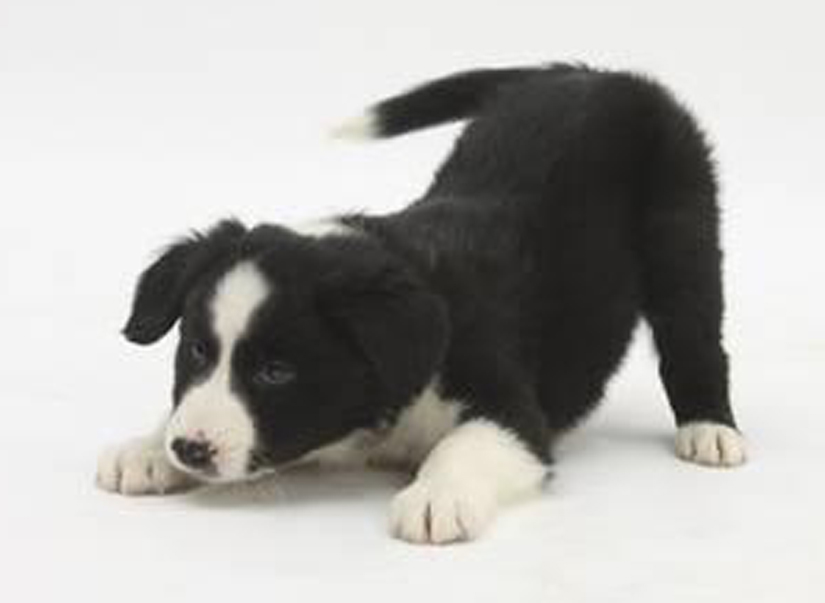
A play bow seems to be an important way a dog communicates with another dog. A play bow is when the front legs are down in front of the puppy and the hind quarters are up in the air with a tail that wags or not. This is an invitation to come and fool around; I want to have some fun. The muscles should be loose and relaxed and not tight and stiff. The play bow also tells the other puppy/dog that if I accidentally nip or bite you I am only fooling and I am sorry. 

A play bow with the puppy running means chase me. If the puppy/dog has a toy in its mouth it is an invitation for the other dog to chase and try to get the toy. 

Wrestling and nipping during play is a way for a puppy/dog to learn how to control its bite. If the puppy continually bites too hard its playmate generally will leave the play and the biting puppy begins to learn a valuable lesson. 

Puppy play is usually mock fighting, it is a way to learn how to fight and protect themselves, but also a lesson in controlling their bite and ferociousness. 


At times the puppies may get into a pinning match where one dog places its head or body over another dog. In play the underdog can usually wiggle out, but once in a while it gets into a growling match as the top dog begins to feel dominant. In this case it maybe necessary for the owners to separate the puppies and get them to calm down. 

A sign of play is loose muscles and joints and they are moving a lot, however a sign of stiff joints and muscles can relate to an over-excited dog that may start a scuffle or fight. In this case redirection of the dog's attention is necessary. 

Puppies/dogs do not have hands and as a result everything must go into their mouths. Chewing is a puppy's way of life and is an important factor in their growing up. As the humans in the equation it is up us to supply proper toys for the puppy/dog to chew on. 

Puppies learn proper behavior when allowed to stay with its littermates and mother until they are at least 8 weeks to 10 weeks old. During that time mom and the siblings have a chance to correct any improper nipping and biting. 


A tug of war is a game puppies/dogs love to play as it gives them a feel of resistance against their teeth and is beneficial in helping to develop jaw and neck muscles. Use and old sock or bandana the goes limp when you or the other puppy lets loose, this is one way to have the dog bring it back to you for more play. Be careful between the ages of 3 to 6 months and do not play too rough as the puppy is getting its adult teeth and you could damage them. 

It is suggested that you play with your puppy/dog for at least 15 to 20 minutes a day and stop when the puppy/dog gets tired or becomes bored. 

Some other things to keep in mind are offer your puppy/dog a fair amount of toys to play with. Do not allow your puppy under a year to jump on couches, beds or on agility jumps as their bones are still fragile. Do not physically punish you puppy by throwing it to the ground or pinning it down if it misbehaves in play. Sometimes an older dog that will play with your aggressive pup can teach it more by a simple growl or snap. Physical punishment is not necessary to teach anyone anything, puppy or child. 

Puppies need to have new experiences and see new things in order to grow into a socially acceptable dog. Do not force your dog to do or face anything it is afraid of. Use treats and praise to show the dog that thunder, yelling children or any thing else it seems fearful of is not scary. 

And most of all let your puppy/dog have at least 30 minutes of free play everyday, having fun is good for us all. Be happy and enjoy your dog and you will have a friend for life.


Source:http://ezinearticles.com/?Playing-is-Important-For-Your-Puppy-or-Dog!&id=2167306