A video from Zak George with his take on how to train your dog to stay with you when off leash.


Thursday, 1 March 2018

Training Your Dog Off Leash

A question I get quite often from new dog owners is, will this basic training have my dog doing everything off leash. And of course my answer is no because basic training is exactly that, it's teaching the dog the basics.
Is having your dog perform all the exercises off leash realistic? Absolutely with the proper training your dog can easily be off leash trained. I always tell people we need to start off with basic training so the dog can perform all the basic exercises without having any type of leash correction.

After we have completed the training stage and the dog is performing well in your home then we continue on to the proofing stage. The proofing stage is where we now start introducing your dog to distractions. The backyard with the leaves, the butterflies and the birds can provide some distraction. The front yard with the leaves, the butterflies and the birds plus cars and people can create more distraction.
The goal for a nicely trained dog that performs all its exercises off leash is that it will perform these exercises no matter what its surroundings are. One of the biggest problems with dog owners however is that they are impatient and they feel that this should all happen in just a matter of days or a couple of weeks and that's not true.

Whether you want to compete in A.K.C. obedience competition or just have a nicely trained dog, training at this level requires time and patients.
Keep in mind that repetition is the number one principle of dog training so to accomplish your goal you should be willing to work with your dog 2 or 3 times daily with short 15 minute sessions.
Over the years I have seen many new dog owners put in the repetitions but their dog does not seem to improve and there is a reason. It is up to the owner to make sure that each training session has a goal. What I mean is that the dog should get just a tiny bit better at an exercise or two with each training session. Remember what I just said not a bunch better, just a tiny bit better with each training session.
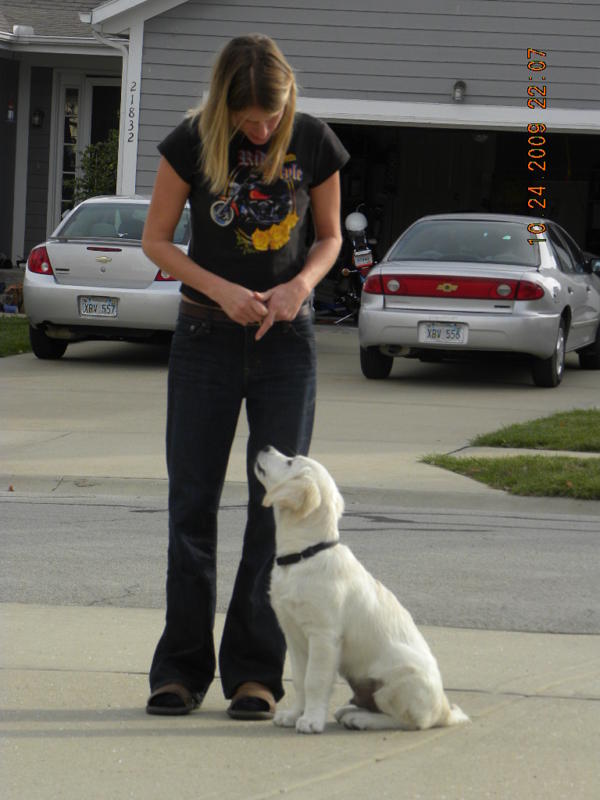
The majority of dog owners never reach the off-leash level with their dogs because they stop training when their dog quits jumping on them or maybe quits pulling them when they go for a walk. If that was their goal then that is okay because everybody has a different goal for their dog.
So if off leash is your goal be sure to tell the trainer that you are working with so that he/she can help you reach that level with your dog.
Source:http://ezinearticles.com/?Training-Your-Dog-Off-Leash&id=8479819
Can Dogs Actually Learn From Each Other?

Quite often I have clients ask if their new dog will learn from their old dog and the answer is Yes, Maybe, Sometimes. But the really important question is whether the new puppy will learn good things or if it will simply learn the bad habits from the old dog.
I really feel that bringing in a new dog and hoping it will learn from the old dog is being a bunch optimistic. One question should be is the old dog so good that we want the pup to be a clone? From what I usually see, that answer is probably no.
I can tell you that the puppy will not learn good obedience however there are a few things that the old dog might teach him. For example the old dog may teach the pup that he can hike his leg and pee where ever he wants in the house.
The old guy may teach the pup how to dig holes in the backyard, especially those holes that go under the fence. I will be willing to bet that the older dog will teach the new kid how to bark at people when they walk by the house and maybe even how they can make the FedEx driver run for his truck when they start growling.
I think you are probably getting the idea about how the training is going to happen.

Now we have been talking about the pup learning from the older dog but guess what? If you are lucky the pup may teach the old dog some new tricks as well. Yep he may teach the older dog that pooping in the house is really not that big of a deal and it sure beats having to go outside to do it. Puppies love to jump on people and on counter tops for example. I have seen situations where the older dog starts doing the same thing.
Dogs are really good at communicating with each other through the use of body language. They can teach the correct thing sometimes if your dog knows what to teach. However please don't ever think that the older dog can take the place of some good obedience training.
If you are toying with the idea of adding a second dog to your home make sure that your current dog has been trained and doesn't have any serious behavior issues so the new pup doesn't learn the wrong things.
Source:http://ezinearticles.com/?Can-Dogs-Actually-Learn-From-Each-Other?&id=8479768
Tuesday, 27 February 2018
5 Types Of Dog Aggression

Aggression in dogs can be a very serious problem that can create a tremendous amount of liability for you and your family. This article deals with five of the most common types of aggression however there are many more. If your dog has aggression and you would like help to resolve it you should contact a qualified trainer or behavior specialist for help.

1. Dominance Aggression. Quite often this type of aggression is directed toward the owner. It can manifest itself when the owner tries to dominate the dog are while making it do something that it does not want to do. Some examples would be waking the dog or making it get off furniture or a bed. This is the type of aggression that happens in what I refer to as aggression in the home where the dog feels that it is the "Alpha".

2. Fear Aggression is very common in the shy fearful dog. Actually the fearful dog is sometimes referred to as the most dangerous dog because you never know when fear will cause aggression to raise its ugly head with this type of dog. A rule to remember and to teach your children is to never try to approach a dog that appears fearful. Cornering a shy, fearful dog can be dangerous since it can't flee so it must fight.

3. Territorial Aggression. We have all seen this dog before. You know the dog that is behind the fence that will not let you are anybody else through the gate. It is guarding its territory no matter where that is. This is the type of dog that is used to guard a business or property.

4. Dog on Dog Aggression is another type of aggression that you just might see in the family dog. This could be the dog that was never socialized properly during the period of socialization that is from birth to 20 weeks of age. If you dog is not socialized with dogs during that period you just may end up with this type of aggression in your dog.

5. Food Aggression is another type of aggression that you may encounter with your dog. The easiest way to avoid this type of aggression is to teach your puppy from the very beginning that the food is yours and you can give it or take it. Start working with your puppy from the very beginning and teaching it that you can put your hands in the food bowl, you can even take the bowl if you want. Do the same thing with treats and bones. If you will teach your pup from the beginning then this should not be a problem in the future.
These are just some of the different types of aggression that you may see in your dog. Socializing your pup before 20 weeks of age will help with some and conditioning your dog to different situations will help with other types of aggression.
If you have an adult dog and it develops aggression be sure and seek the help of a trainer or behavior specialist that is qualified to help with the problem. Trying to resolve aggression on your own can be very dangerous.
Source:http://ezinearticles.com/?5-Types-Of-Dog-Aggression&id=8419400
Monday, 26 February 2018
How To Teach a Shy, Fearful, or Nervous Dog!
A video from Zak George on how to teach a shy, fearful or nervous dog.
How To Help A Shy, Fearful Dog

Do you have a dog that is shy and fearful? You know the dog I am talking about. It will not approach new people and is very fearful in new situations and environments. I understand this type of problem and I also realize how concerned you are about the fact that your dog is suffering. Here are a few things you might want to try to help the situation.
Obedience Training

Yes the very first thing to do for a shy fearful dog is to do some obedience training. Training can give a shy dog a new level of confidence and a feeling of accomplishment. Since your dog is uneasy in strange places training should be done privately in your home where your dog is very comfortable. In this type of case group training is out of the question.
Limited Socialization
What I mean by limited socialization is to start taking your dog to new places. For example you might go to the parking lot of the local strip mall. Take your dog for a walk around the outer perimeter of the parking lot just to get it used to being in strange new places. As the days go on and the dog gets more and more comfortable in these new surroundings start moving in closer where you might walk in proximity to other people without actually coming into contact with them.

As the sessions continue you should get to a point where you can take your dog on the sidewalk outside of a store while people pass in and out of the stores. You should see your dog getting more and more comfortable as the sessions continue. Please keep in mind that this is a slow process. How slow, depends on your particular dog and the extent of the problem.
I always suggest that this limited socialization should be done 3 times a week and be sure to vary the location.
Thunder Jacket
 |
| Thunder Shirt |
Something that may help a fearful dog is a Thunder Jacket. They are available at the big box pet stores as well as online. It is a fabric jacket or wrap that goes around your dog snuggly. The effect of a thunder jacket varies widely from dog to dog. Some dogs are immediately helped when wearing the jacket while others get no benefit at all. I always tell my clients to save the receipt and all the packaging so you can return it after you have given it a few day trial if it does not work for your dog.
D.A. P.
 |
Dog Appeasing Pheromone |
D.A.P. is a product that you may want to try to help your dog feel more comfortable in stressful situations. It is a pheromone that mimics the smell of a lactating mother dog and supposedly dogs never forget that smell and it relaxes them. It is available as a collar, a spray and also an atomizer that you plug in the wall. Most of my clients prefer the spray. They can use in on a neckerchief around the dogs neck or even on a pillow in the car or other location.
If you have a dog that suffers from shyness and fear give these tips a try. Do not expect instant success. It will take some time so be patient.
Dource:http://ezinearticles.com/?How-To-Help-A-Shy,-Fearful-Dog&id=8419442
Sunday, 25 February 2018
Is Your Dog Showing Aggression In The Home?

Aggression in the home has become an epidemic. What I mean by aggression in the home is where your dog has possibly bitten the kids, the adults and even the other dog in the house. Sometime it hasn't gone that far yet however the dog does growl at you when you try to get it off the couch or the bed.
Quite often the dog that is showing aggression in the home is great with strangers in or out of the home. The good thing about this problem is that about 95% of the time it can be fixed with some training and some behavior modification. The hardest thing is finding a trainer or behavior specialist that has experience solving this type of problem.

When we see this type of aggression it is because the dog has gotten to a point where it thinks it is the alpha in the home. It does not want to be corrected by somebody else in the pack that is not above it.
Almost every time that we see this problem we are dealing with an untrained dog. When we talk about a trained dog I am referring to obedience training. Obedience training is what establishes you the owner as the alpha in the home. Without obedience training the dog doesn't know who the alpha is so it assumes the position.

The obedience training exercises you will need to do include the sit, down, sit-stay, down-stay as well as the recall (come). You will also train your dog to walk nicely on a loose leash (heel) so it does not drag you down the street.
Along with the obedience training you will be doing some behavior modification. What type of behavior modification depends on your dog and the extent of the aggression problem.
Usually this problem will not appear until sometime between 12 and 24 months of age and will actually get worse as the dog gets older. The sooner the problem is corrected the better chances you have of correcting the problem. The longer your dog shows this aggression then it starts to be a learned response and is harder to correct.
If you have aggression in the home with your dog find a good trainer and/or behavior specialist in your area that has experience with this specific problem. Remember start the corrective action early before it is too late and before someone in your home is seriously injured.
Source:http://ezinearticles.com/?Is-Your-Dog-Showing-Aggression-In-The-Home?&id=8419475
Subscribe to:
Posts (Atom)